

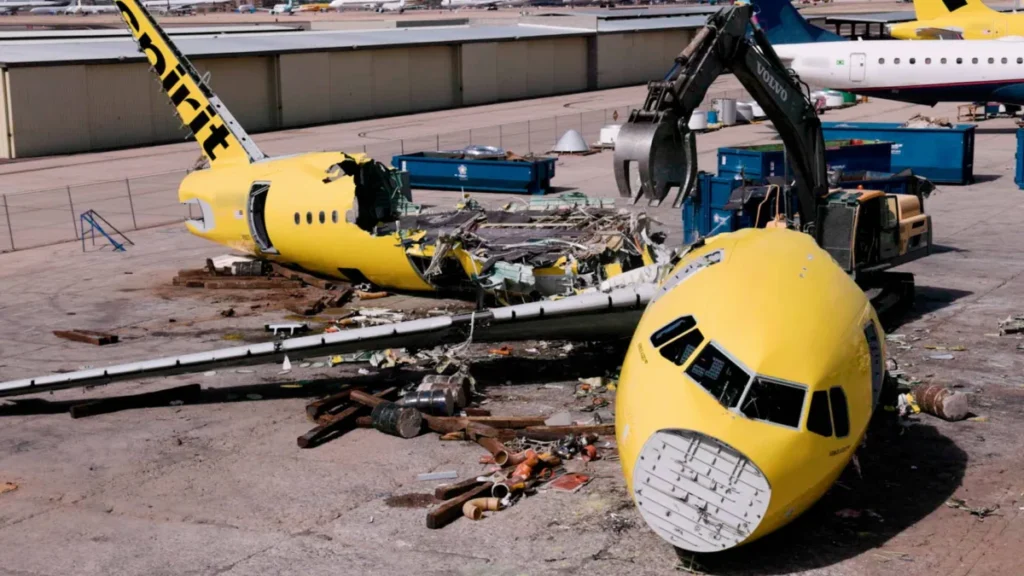
GOODYEAR, Ariz. — When a brand-new Airbus A320neo rolled off the factory line in Mobile, Alabama, in July 2022, it gleamed in a bright yellow coat of paint, destined to join the fleet of Spirit Airlines. Like countless narrow-body aircraft built by major manufacturers, it was engineered to take to the skies for decades, carrying millions of passengers across domestic and international routes while offering fuel efficiency and modern comforts.
Yet, less than four years later, that very same airplane met a swift and definitive end. Parked at an aircraft asset management and maintenance facility on the sun-baked outskirts of Phoenix, Arizona, the jet was systematically stripped of every valuable component. Once its multi-million-dollar parts were safely extracted, the steel teeth of a heavy industrial excavator tore aggressively through its aluminum fuselage, crushing it into a mangled heap of metal destined for the smelter.
Across the global aviation sector, a profound shift is underway. Industry executives and asset management specialists say a growing number of commercial aircraft are being dismantled years—and sometimes decades—earlier than expected. This unusual phenomenon is driven by a severe and persistent shortage of aircraft components, led by a desperate scramble for engines, landing gear, and specialized electronics that has plagued commercial airlines, leasing firms, and maintenance facilities for years.
The crisis has turned traditional aviation economics on its head, turning modern, highly capable jets into more valuable commodities when dead than when alive. For asset trading firms, the math is simple: the parts hidden inside a young plane can generate far more revenue on the secondary market than waiting out long backlogs for engine repairs, paying continuous storage fees, or attempting to sell the aircraft in a constrained market.
"It’s the first time in my career that involved purchasing an aircraft that’s less than five years since date of manufacture," said Bill Thompson, vice president who leads aircraft and engine acquisition for the Americas at aviation asset management and trading firm EirTrade Aviation. His company purchased the less than four-year-old Airbus A320neo earlier this year, along with another similarly aged aircraft, paying "single-digit" millions for each.
Thompson expects EirTrade to turn a healthy profit after harvesting more than 1,000 distinct parts from each jet before sending the remaining carcasses to be crushed. When asked if even the galley equipment finds a buyer, he noted the pragmatism of the aftermarket parts trade: "I don’t know if you’re going to sell the coffee makers, but you never know. Sometimes you do."
‘Don’t Fall in Love with the Metal’
The practice of tearing down young airplanes is no longer an isolated anomaly. Data compiled by aviation advisory firm IBA Group reveals that 21 newest-generation aircraft were dismantled between June 2025 and August. These scrapped planes had an average age of just 6.4 years and consisted predominantly of modern Airbus jets alongside select Boeing models. By comparison, the historical average retirement age for a narrow-body commercial airplane hovers around 21.7 years, underscoring just how radically current market pressures have distorted typical aircraft lifecycles.
"Anytime that you end up with any period of market softness in aircraft availability, engine availability, it’s going to cause investors to look at other options," explained Simon Goodson, CEO of AerFin, an international firm specializing in the acquisition, sale, repair, and leasing of commercial aircraft and parts. Summing up the ruthless financial calculus driving the trend, Goodson added, "We always say to our aircraft and engine traders, ‘Please don’t fall in love with the metal.’"
In a normal operating environment, hundreds of older aircraft are retired annually as aerospace manufacturers ramp up production lines to supply airlines with newer, cleaner, and more fuel-efficient models. These aging planes are systematically swapped out and replaced, filtering down to secondary operators or heading to the desert for gradual retirement.
However, the current crisis stems from a different set of pressures. Beyond retiring legacy jets, some aircraft owners are simply unwilling to endure the agonizingly long wait times required to secure replacement parts or major repairs for their younger, high-value jets.
"A year might not sound that long, but does three or four years?" asked Dave Querio, CEO of Ascent Aviation Services, a prominent company based in Marana, Arizona, that handles aircraft repairs, modifications, storage, and disassembly. "That’s the issue for the aircraft that came in in ’23, ’24, and ’25."
In many cases, owners realize they can reap significantly more capital by parting out a young aircraft immediately than by selling the airframe outright or continuing to rack up steep storage fees while waiting indefinitely for maintenance slots to open. Querio noted that the sheer volume of younger aircraft being sent to the chopping block is unlike anything he has witnessed in his career.
A Red-Hot Engine Market
At the heart of these premature retirements is an acute scarcity of commercial jet engines, accompanied by soaring costs and lengthy backlogs at repair facilities.
A major catalyst for the bottleneck is the reality facing cutting-edge engines designed to burn hotter and deliver superior fuel efficiency. These high-tech powerplants are experiencing wear and tear that requires heavy maintenance visits far earlier than airlines and manufacturers originally anticipated. Consequently, engine repair and overhaul shops—ranging from facilities operated by manufacturing titans like GE Aerospace and RTX unit Pratt & Whitney to independent operators—are severely backlogged.
Faced with grounded fleets and missed revenue, airlines and leasing companies have been forced to hunt for spare parts and operational engines wherever they can be found. This desperate search frequently leads them to desert storage yards in the American Southwest, where parked aircraft serve as lucrative donor vehicles.
This dynamic has poured fuel onto an already heated secondhand parts market. According to industry experts, individual engine fan blades for large commercial jets can fetch anywhere from $50,000 to more than $100,000. Furthermore, engines powering specific families of Airbus A320neo aircraft require 20 of these precision-engineered blades. Other vital internal components, such as an engine disc, can command between $1 million and $2 million on the open market.
The crunch was heavily exacerbated by a major engine recall initiated due to a manufacturing defect involving contaminated powdered metal used in certain turbine components. The recall backed up repair shops globally and grounded hundreds of Airbus aircraft. Spirit Airlines bore a disproportionate share of this operational burden in the United States, suffering severe disruptions years before the carrier ultimately collapsed.
The engines affected by the recall, manufactured by Pratt & Whitney, command astronomical values. High-end valuations for these powerplants reached close to $17 million, marking a staggering 60% increase from the upper end of their pricing range in 2019, according to IBA data.
With replacement engines scarce, carriers have increasingly resorted to scavenging powerplants from retired or grounded airframes to keep their active fleets moving. "So you’re just playing Legos and moving engines on and off aircraft," said Mike Stengel, a partner at aerospace consulting firm AeroDynamic Advisory.
These severe supply constraints have driven the cost of purchasing or renting a popular commercial engine to unprecedented heights. Renting a single engine now commands between $160,000 and $180,000 per month, according to IBA data. Competing engines for the A320neo family produced by CFM International—a joint venture between GE Aerospace and France’s Safran—offer little relief, commanding a comparable monthly rental range of $130,000 to $180,000.
Spirit Airlines’ Ghost Planes
The trend of scrapping young aircraft predates the ultimate collapse of Spirit Airlines, as demonstrated by the four-year-old Airbus jet dismantled outside Phoenix. That particular aircraft had been sidelined and placed into long-term storage due to the industry-wide engine recall, remaining idle until its owners decided its parts were worth more than its future potential.
However, the demise of Spirit Airlines has injected a massive wave of additional inventory into the market, accelerating these difficult decisions for aircraft owners and lessors.
On a scorching afternoon in late June, just weeks after Spirit’s sudden collapse, dozens of the airline’s idle, bright yellow planes sat baking under the desert sun at AerSale’s storage facility in Goodyear, Arizona. The transition was so abrupt that former Spirit pilots visiting the facility could still find remnants of the carrier’s operations. Glenn Zecchin, a former Detroit-based Spirit captain now flying corporate jets, stopped by to check on the aircraft he once piloted.
"I knew the airplanes were there, and I wanted to see what happened," Zecchin said. Inside the maintenance hangars and parked jets, reminders of the carrier’s sudden end remained visible: in-flight menus and safety cards still tucked into the bungee cord seatbacks, with pilot manuals resting undisturbed in the cockpits.
Not all of the grounded Spirit fleet is destined for immediate destruction. Some asset owners may choose to keep specific airframes in storage or remarket them to other carriers. Potential future operators might elect to gut Spirit’s characteristically tight 28-inch seat pitch in favor of more spacious cabin configurations.
Yet every month an aircraft spends parked on the ground accumulates substantial storage fees. Because arid desert climates naturally prevent corrosion and preserve structural integrity better than humid environments, aircraft can theoretically sit in these facilities for decades.
Even so, if the aftermarket demand for components remains high and the wait times to make a plane airworthy stretch out too far, the economic tipping point is easily reached.
"After you get rid of all the valuable equipment and sell it back into the aftermarket, what’s really left is just a metal carcass that you will literally take a crane and crush," Stengel said, noting that the remaining shell is typically sold off to recyclers to be repurposed into items as varied as aluminum beverage cans.
For industry veterans who spent years working with these modern jets, witnessing their premature destruction evokes a mixture of stark realization and melancholy.
"It’s a little melancholy to watch it at times," Querio admitted. "But sometimes, it’s kind of a thrill to … see how fast an aircraft can be crunched up and sent off to the smelter."