DETROIT — The sprawling industrial landscape of the American automotive sector is undergoing a subtle but profound transformation. In the heart of the Motor City and across its neighboring manufacturing hubs, the rhythmic hum of traditional assembly lines is being supplemented by the precise, quiet work of additive manufacturing. Automakers, including industry giants Ford Motor and General Motors, alongside high-growth electric vehicle challenger Rivian Automotive, are increasingly integrating 3D printing into their core operations, shifting the technology from a niche prototyping tool to a critical component of mass production.
This strategic pivot is driven by an industry-wide mandate to trim costs, compress development timelines, and maintain a competitive edge in an era defined by rapid technological shifts. While 3D printing—the process of creating three-dimensional objects from digital files by depositing materials layer by layer—has existed for decades, its application within automotive manufacturing has reached a new level of commoditization. Today, these printers are tasked with everything from generating functional vehicle parts and interior accessories to crafting specialized tools for assembly plants and intricate testing units for research and development laboratories.
The Strategic Shift Toward Additive Manufacturing
For companies like Rivian, the transition is not merely experimental; it is foundational. Jared Beck, who leads additive manufacturing at the EV startup, describes the shift as a necessary evolution for a company looking to scale quickly in a crowded market. During a tour of Rivian’s extensive 3D-printing facilities in suburban Detroit, Beck emphasized that the technology is being woven into the very fabric of the company’s internal culture.
"At this point, we don’t have a choice but to scale up and begin using it through all factions of Rivian," Beck told CNBC. "We’re going to be democratizing 3D printing for the entire company."
The concept of additive manufacturing is deceptively simple: it mimics the logic of a standard inkjet printer, but instead of paper and ink, it utilizes a sophisticated array of materials, including advanced polymers, composites, ceramics, and metals. The primary appeal lies in the ability to move directly from a digital design to a physical object without the need for expensive, time-consuming molds or traditional machining setups.
For Rivian, the investment has been substantial. The company has poured more than $5 million into its printing infrastructure, with an additional $1.7 million committed annually to the raw materials required to feed its fleet of machines. Despite these significant capital expenditures, the return on investment is often realized within a single year. By circumventing traditional supply chain hurdles, Rivian has managed to streamline logistics and reduce production times for complex components from weeks to mere days, or in some instances, hours.
"It’s well in the millions [for savings], but the main thing is speed for Rivian," Beck explained.
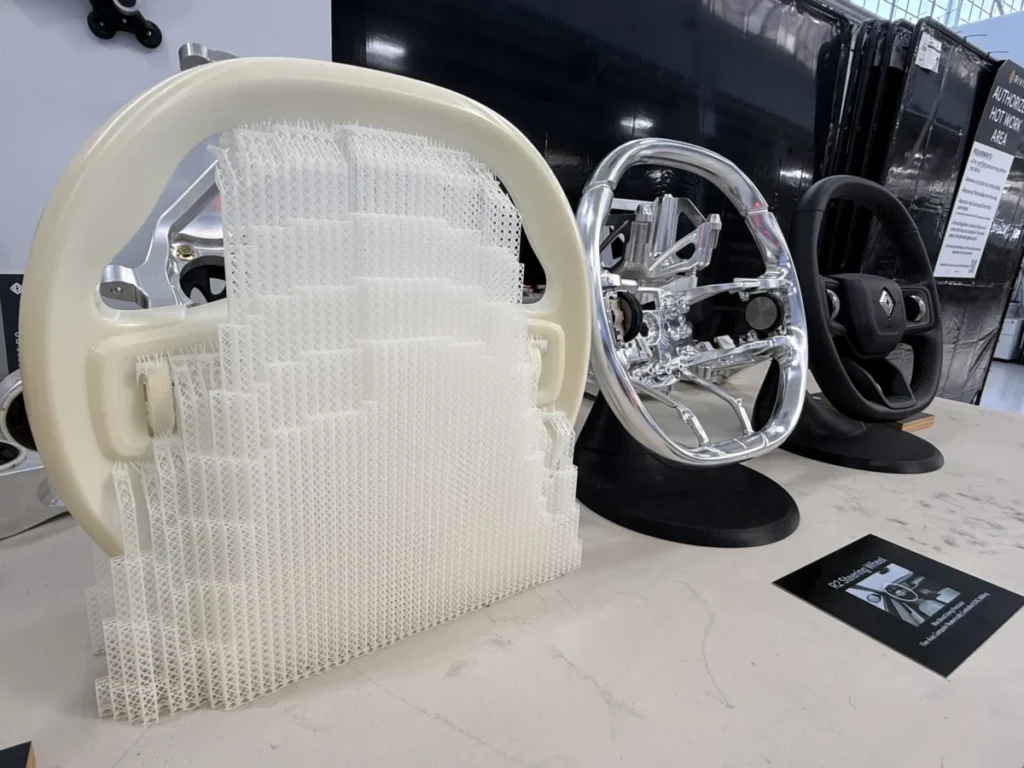
The company is now pushing the boundaries of what these machines can achieve. Recent expansions include the integration of technology capable of producing flexible silicone parts, as well as the installation of dedicated 3D-printing bays at its manufacturing plant in Normal, Illinois. This decentralized approach allows engineers to print parts on demand, fostering a culture of rapid iteration. According to Beck, the goal is to ensure that 3D prints are readily available to every engineer, allowing them to hold a physical version of their design in their hands as quickly as possible. Rivian has already utilized the technology for diverse applications, including electric-motor models for fluid testing, intricate screw guides for tooling, and even production-ready trim pieces used to close gaps in early-build vehicles.
Scaling and Standardization at Ford and General Motors
While startups like Rivian are building their additive capabilities from the ground up, legacy automakers Ford and General Motors are leveraging their massive existing infrastructure to integrate 3D printing at scale. Rather than centralizing operations in a single facility, Ford has opted for a distributed model, embedding additive manufacturing departments directly into its various assembly plants.

A prime example of this strategy is located near Ford’s headquarters in Dearborn, Michigan, where the company has introduced a "vending machine" for 3D-printed parts directly on the shop floor. This initiative is designed to empower team leaders, providing them with immediate access to essential components and tools without the administrative friction of traditional procurement.
Gregory Foresi, a mechanical engineer who oversaw Ford’s 3D-printing lab at the River Rouge factory through early 2024, noted the efficiency gains. "By putting the vending machine up, all the team leaders have access," Foresi said. "We’re able to keep that thing stocked rather than have a bunch of parts laying around in the lab. So that’s been pretty huge."
In his tenure at the plant, Foresi managed a cluster of roughly two dozen printers to produce thousands of specialized tools, ranging from torque bit sockets to custom hand tools designed to assist in adhesive application. Employees are encouraged to use a dedicated internal app to request specific tools or parts, which are then vetted and printed by the additive manufacturing team. This process not only provides cost savings but also offers a level of design flexibility that traditional manufacturing cannot match.
In instances of supply chain disruption, 3D printing has served as a vital safety net. Foresi recalled a situation where a large machining wheel was required to maintain assembly line production. When a standard supplier-provided part was unavailable, the team successfully 3D-printed a temporary, functional replacement. While Foresi acknowledged that the printed component did not match the longevity of a permanent part, it successfully prevented costly downtime, proving the technology’s worth as a critical operational tool.
Ford’s commitment to this technology is robust; the automaker expects to have dedicated 3D-printing labs operational in more than 23 plants by the end of the year. With a fleet exceeding 200 machines, Ford is aggressively expanding the footprint of additive manufacturing within its global production network.
General Motors, meanwhile, has taken a more targeted approach, focusing on high-value applications and low-volume, bespoke production. GM utilizes industrial-grade printers from Stratasys, which can command prices in the hundreds of thousands of dollars depending on the required specifications and certification levels. This high-end hardware is currently being used to produce 135 unique components for the ultra-luxury Cadillac Celestiq, a vehicle that epitomizes the move toward mass customization. Additionally, 3D-printed parts have found their way into the performance-oriented Cadillac Blackwing sedans, including a unique, personalized medallion on the manual shifter knob.
Fadi Abro, senior global director of automotive and mobility at Stratasys, has observed the evolution of GM’s strategy as a benchmark for the industry. "GM has been a great example of how companies can ‘standardize and then scale’ 3D printing," Abro noted. He attributes the rapid adoption of the technology to significant improvements in material science, which have made 3D-printed components durable and reliable enough for automotive-grade applications. "The material properties improved so significantly that the use cases improved," Abro said. "From a product perspective, we have to get the technology to become faster and more accessible, in an economic sense."
As the automotive sector continues to lean into this additive future, the focus remains clear: speed, efficiency, and the ability to innovate on the fly. Whether it is a startup printing a mascot in a lab or a legacy manufacturer producing thousands of specialized tools in a factory, 3D printing has moved firmly out of the realm of novelty and into the essential machinery of modern car production. The technology has proven its utility, and as costs continue to decline and material science advances, it is poised to play an even larger role in how the world’s vehicles are conceived, tooled, and assembled.