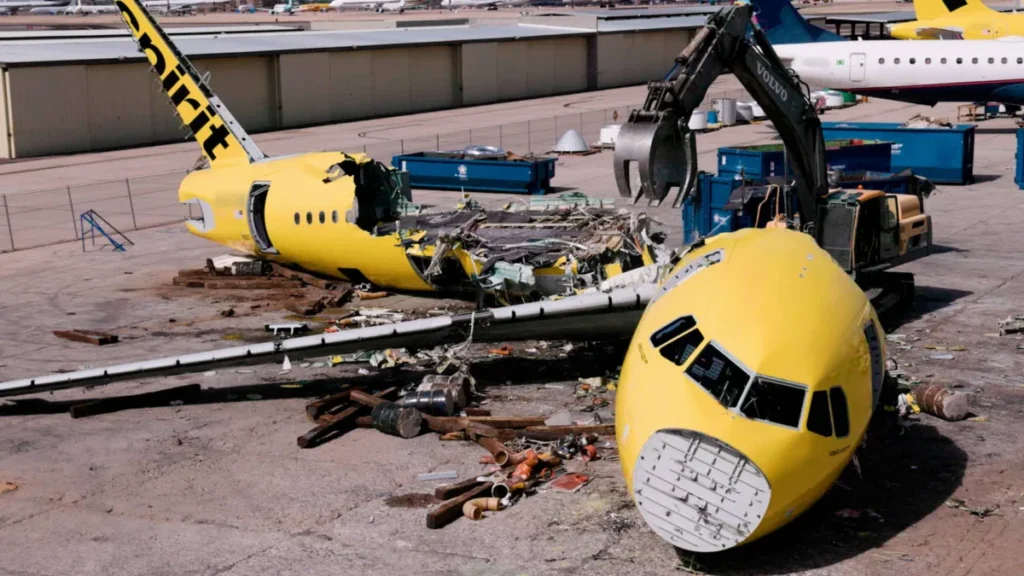
GOODYEAR, Ariz. — In the sweltering heat of the Arizona desert, the metallic screech of an excavator tearing through an Airbus A320neo fuselage serves as a jarring coda to a short-lived career. The aircraft, which rolled off the assembly line in Mobile, Alabama, in July 2022, was intended to ferry passengers across the skies for decades. Instead, less than four years after its maiden flight, it has been systematically dismantled. Its valuable components were stripped for resale, and its once-pristine shell was reduced to scrap metal.
This is not an isolated incident of an aging, inefficient jet reaching the end of its natural life. It is the new, paradoxical reality of the modern aviation industry, where the most advanced, fuel-efficient aircraft in the world are being sacrificed not because they are broken, but because their individual components—specifically their engines—have become more valuable than the planes themselves.
Industry executives confirm that a growing number of aircraft are being dismantled years, or even decades, ahead of schedule. The catalyst for this trend is a persistent, crippling shortage of replacement parts. As supply chains struggle to keep pace with demand, the market for aircraft engines, landing gear, and even minor avionics has reached a fever pitch, forcing owners to make cold, calculated decisions about the utility of their assets.
A Radical Shift in Asset Management
For veterans of the aviation industry, the current environment is unprecedented. Bill Thompson, the vice president of aircraft and engine acquisition for the Americas at EirTrade Aviation, acknowledges that the decision to tear down a sub-five-year-old aircraft was once unthinkable. EirTrade, which purchased the young Airbus A320neo earlier this year, represents a growing segment of the market that prioritizes the “parts bin” over the airframe.
"It’s the first time in my career that involved purchasing an aircraft that’s less than five years since the date of manufacture," Thompson noted. When EirTrade acquired that specific A320neo and a sibling aircraft of similar vintage, the firm paid "single-digit" millions for each. The strategy is clear: the cumulative value of the more than 1,000 individual parts harvested from these jets far exceeds the value of the completed aircraft in a market where they might otherwise sit idle for years.
The process is surgical. Engineers and technicians remove everything of value—avionics, flight controls, landing gear, and, most importantly, the power plants. In some cases, even the cabin interior, including coffee makers and galleys, is salvaged for the secondary market. As Thompson wryly observes, the market is so hungry for components that even the smallest items find a buyer, though the primary focus remains on the high-value systems that keep the global fleet operational.
The ‘Don’t Fall in Love with the Metal’ Philosophy
The numbers tell a story of an industry under immense pressure. Data from the aviation advisory firm IBA Group reveals that twenty-one of the newest-generation aircraft were dismantled between June 2025 and August of this year. These scrapped planes had an average age of just 6.4 years—a stark contrast to the historical norm, where a narrow-body aircraft typically remains in service for over 21 years before retirement.
This shift in strategy is summarized by Simon Goodson, CEO of AerFin, a firm specializing in the acquisition, repair, and leasing of aircraft components. "Anytime that you end up with any period of market softness in aircraft availability, engine availability, it’s going to cause investors to look at other options," Goodson said. "We always say to our aircraft and engine traders, ‘Please don’t fall in love with the metal.’"
For many owners, the math has become increasingly simple. The traditional model of keeping an aircraft in storage while waiting for a maintenance slot or a backordered part is no longer economically viable. Storage fees in desert facilities, while lower than those in major hubs, still accumulate over time. When a plane is grounded for years, the opportunity cost of the capital tied up in the airframe becomes unsustainable. By dismantling the aircraft, owners can recoup their investment almost immediately by feeding the starving aftermarket with desperately needed spares.
Dave Querio, CEO of Ascent Aviation Services in Marana, Arizona, has witnessed this acceleration firsthand. His facility, which handles storage, modification, and disassembly, is seeing a surge in demand for the teardown of relatively new jets. "A year might not sound that long, but does three or four years?" Querio asks, referring to the wait times for critical repairs. "That’s the issue for the aircraft that came in in ’23, ’24, and ’25."
The Engine Crisis: A Market Gone Hot
At the heart of this disruption is the acute shortage of jet engines. Modern engines, designed to run at higher temperatures to achieve superior fuel efficiency, have proven to be more maintenance-intensive than originally projected. This has created a massive bottleneck at repair and overhaul facilities operated by industry giants like GE Aerospace and the RTX unit Pratt & Whitney.
The resulting scarcity has turned the secondhand engine market into a high-stakes arena. An engine fan blade for a smaller jet can fetch $50,000, while those for larger aircraft can exceed $100,000. For a typical A320neo engine, which utilizes 20 such blades, the replacement costs are staggering. A single engine disc can be valued between $1 million and $2 million.
The situation was exacerbated by a significant manufacturing defect in Pratt & Whitney engines, which led to a widespread recall in 2023. The discovery of contaminated powdered metal used in the production of turbine discs forced airlines to ground hundreds of aircraft globally for prolonged inspections and repairs. Spirit Airlines, which eventually collapsed, felt the impact of these engine issues acutely, as many of its aircraft were trapped in the inspection cycle for years.
According to IBA, the market value of these engines has soared, with high-end models now worth approximately $17 million—a 60% increase compared to 2019 price points. With new engines unavailable and repair queues stretching into the distant future, airlines are forced to play what Mike Stengel, a partner at the consulting firm AeroDynamic Advisory, calls "Lego" with their fleets. They are cannibalizing retired or grounded aircraft just to keep their active planes flying.
The financial burden of this shortage is reflected in rental rates. Leasing a popular engine for an A320neo currently costs between $130,000 and $180,000 per month, a figure that reflects the extreme scarcity of available power plants.
Spirit Airlines and the Desert Graveyard
The aftermath of Spirit Airlines’ collapse has provided a somber look at this trend. At AerSale’s facility in Goodyear, the desert floor is littered with yellow-painted aircraft that once formed the backbone of the airline’s fleet. During a visit in late June, the scene was one of suspended animation: safety cards remained in the seatbacks, and pilot manuals were still stowed in the cockpits of planes that will likely never carry a passenger again.
For some of the former Spirit jets, the future remains uncertain. They may be sold to other carriers that are willing to undertake the necessary modifications, such as replacing the high-density, 28-inch seat pitch for a more comfortable cabin configuration. However, for many, the cost of bringing a grounded aircraft back into service—including the immense task of sourcing an engine—simply doesn’t make sense.
When an aircraft is deemed a "parts donor," it begins a final, methodical disassembly. The high-value components are cataloged, certified, and returned to the supply chain. What remains is a hollow aluminum shell, a testament to the fleeting nature of modern aerospace assets.
"After you get rid of all the valuable equipment and sell it back into the aftermarket, what’s really left is just a metal carcass that you will literally take a crane and crush," Stengel explained. The remains are then sold to recyclers to be repurposed into anything from beverage cans to industrial materials.
For those who spend their lives around these machines, the process is a mixture of professional necessity and lingering sadness. "It’s a little melancholy to watch it at times," Querio admitted. "But sometimes, it’s kind of a thrill to see how fast an aircraft can be crunched up and sent off to the smelter." In the current economic climate, the speed of that process is the only thing keeping the rest of the world’s commercial fleet in the air.