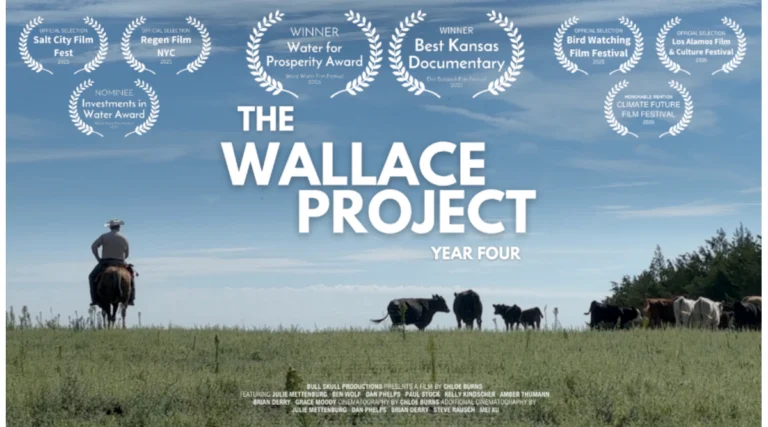
WALLACE, Kan. — The Wallace Project: Year Four, a compelling short documentary chronicling a groundbreaking grassland restoration initiative in Western Kansas, has earned international recognition by winning the Water for Prosperity award at the prestigious IHE Delft Institute for Water Education in the Netherlands.
Presented on September 26, the international honor highlights media projects that successfully recognize the complex, interconnected relationships between water, food, energy, local livelihoods, sustainable development, and economic opportunity. The World Water Film Festival (WWFF), which previously selected the 17-minute documentary as an official selection earlier in the year, announced the win to international audiences, cementing the project’s footprint on the global stage of environmental advocacy and resource management.
The award was formally presented by Robert Strand, the founder of the World Water Film Festival, alongside Lineke Schrijver, an Associate Programme Management Officer for the United Nations Division for Sustainable Development Goals.
Reflecting on the mission of the festival and the power of visual storytelling, Strand emphasized the core philosophy driving the initiative. “Our goal is to leverage the power of art to build advocacy,” said Strand, who established the WWFF in 2022. “When people feel water stories, they can act on water futures.”
The documentary’s international acclaim extends beyond its recent victory. The Wallace Project: Year Four was nominated in two distinct, highly competitive categories inspired by the United Nations: “Water for Prosperity” and “Investments in Water.” According to the World Water Film Festival, these specific categories were directly inspired by the Interactive Dialogues of the 2026 UN Water Conference, an arena where the WWFF is officially credentialed to participate this coming December.
At its core, the film captures four years of intensive, transformative regenerative grazing implementation across 2,740 acres of marginal cropland located in Wallace County, Kansas. This region of the American Great Plains sits directly above the rapidly depleting Ogallala Aquifer, which has already lost an alarming 80 percent of its historical water supply. This profound and escalating water crisis has cast a heavy shadow of doubt over the long-term sustainability of traditional, intensive cropping practices that heavily rely on depleting fossil water from the aquifer for production.
“Our nomination in these categories, and our win for the Prosperity Award, speaks to the potential for managed grazing to provide a solution to our most pressing agricultural challenges,” says Julie Mettenburg, the founder and chief executive officer of The Provenance Co., the organization behind the ambitious restoration effort.
Mettenburg speaks from a deeply personal understanding of the stakes involved in modern agricultural transitions. In parts of Kansas, hydrologists and agricultural economists predict that the Ogallala Aquifer has as few as twenty-five years of productive capacity remaining, meaning the vital underground water source could be effectively exhausted within her children’s lifetimes.
“It will run out in my children’s lifetimes. I dedicated myself to this work to secure a livable future for them. Being selected for a festival like this tells me we’re not alone,” Mettenburg explains, noting that the international validation provides vital encouragement for rural communities grappling with the harsh realities of resource depletion.
The documentary’s journey through the film festival circuit has been robust since its premiere in New York City on Earth Day 2025, where it debuted as part of the RegenNYC Film Festival. Since then, the film has been selected and screened by multiple independent and environmental film circuits, including the world-touring Climate Future Film Festival and the Los Alamos Film and Culture Festival in New Mexico. Domestically, the film’s powerful storytelling resonated deeply within the regional agricultural community, capturing the coveted Best Kansas Documentary award at the 2025 Doc Sunback Film Festival held in Mulvane, Kansas.
Produced as a critical component of The Provenance Co.’s overarching organizational mission, the film aims to share the harrowing yet hopeful story of Western Kansas while demonstrating the vast potential for large-scale grassland and water restoration through the Holistic Management of livestock. The documentary intimately details the multi-year ecological transformation of marginal dryland cropping acreage back into a thriving, perennial grassland system—a deliberate strategic maneuver designed to foster long-term ecological and economic resilience in a critical ecosystem facing unprecedented climatic and hydrological pressures.
“Bringing grazing livestock back in a way that mimics nature, with behavior simulating the former bison herds, is one way to restore whole system health while retaining a profitable enterprise,” Mettenburg noted, explaining the science and philosophy underpinning the project. “The challenge is finding the financial pathway through a transition back to perennial production, in a place where the land is marginal without irrigation, so that is what this project focused on.”
The transition of commercial-scale cropland back to a functional, permanent grassland ecosystem relying solely on managed grazing represents a pioneering, first-of-its-kind project for the region. As the official timeline of the Wallace Project wraps up in 2026, The Provenance Co. is already actively engaged in developing new initiatives designed to move this innovative concept further down the path toward broad-scale feasibility, commercial viability, and widespread agricultural adoption. To achieve this, the company routinely partners directly with private landowners, agricultural operators, and specialized financing groups interested in sustainable land use.
Production duties for the documentary were handled by Bull Skull Productions, an independent filmmaking outfit based in Lawrence, Kansas. For the creative team behind the lens, the project was far from a detached journalistic assignment; it was an extension of their own lived experiences within the agricultural sector.
“It means so much to have our work acknowledged,” says Chloe Burns, the founder of Bull Skull Productions and the communications manager for The Provenance Co. Notably, Burns is also the daughter of CEO Julie Mettenburg. Together, they represent sixth- and seventh-generation members of a dedicated Kansas farm family based out of Princeton, Kansas, who originally made the pivotal decision to transition their family operation to Holistic Management practices back in 2014.
For Burns, chronicling the trials and triumphs of the Wallace Project was an intensely personal endeavor driven by firsthand empathy for the agricultural community.
“I made this film because I’ve done the work of regenerative ranching. I know how hard it is and how isolating it can feel. I wanted to give recognition to the people on the ground making real change,” Burns shares.
Burns traveled to the Netherlands to accept the prestigious award on behalf of the dedicated project team working on the ground in Wallace, individuals who captured a significant portion of the raw, authentic footage during the grueling course of their daily physical work on the land.
“Winning this award, from a festival focused on environmental solutions like the World Water Film Festival, is a tremendous honor. Our work is just beginning,” Burns says.
The director’s cut of The Wallace Project: Year Four has a runtime of 17 minutes and 29 seconds. The complete film is currently available for public viewing online through The Provenance Co.’s official digital platform, while an introductory trailer can be accessed via major video-sharing networks.
Beyond its hands-on land restoration projects, The Provenance Co. continues to offer comprehensive consulting services in regenerative grazing management, along with dedicated training and educational programs. These educational offerings include providing accredited-level training in Holistic Management in partnership with the Savory Institute based in Boulder, Colorado.
As the organization looks toward the future, the global recognition of The Wallace Project: Year Four serves as a powerful testament to the viability of ecological restoration, proving that local actions taken in the high plains of Western Kansas can resonate across international borders and inspire global conversations about water, land, and sustainable human futures.