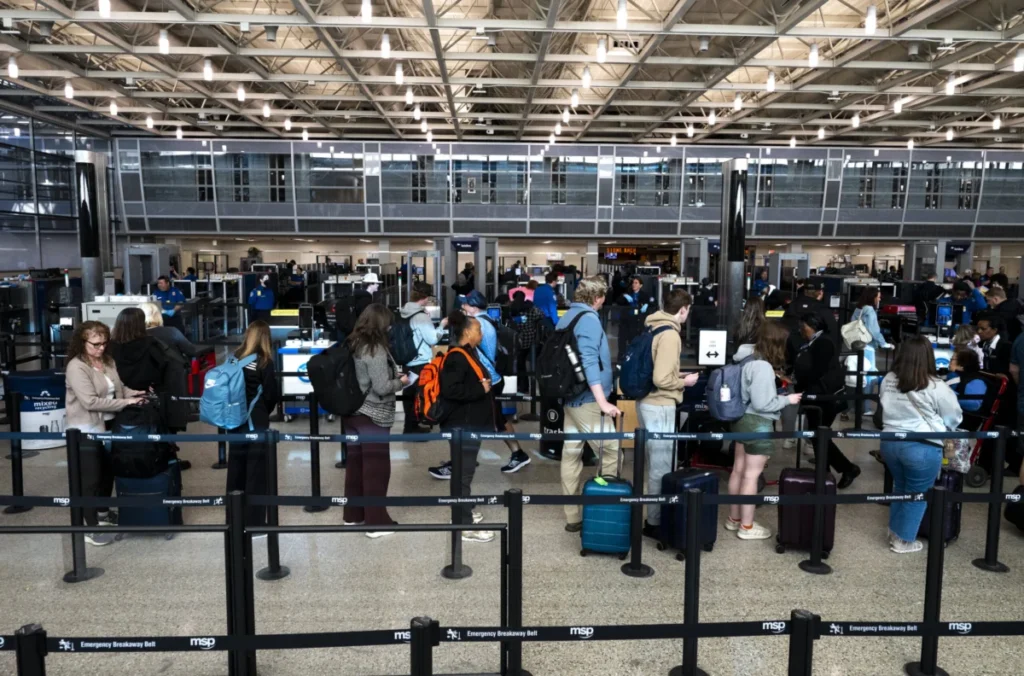
MINNEAPOLIS — Travelers navigating security checkpoint lines at major airports across the United States this year are encountering a subtle yet profound shift in how the aviation industry operates. While the total volume of passengers flying is on track for its first annual decline since 2020, major U.S. carriers are viewing the trend with a surprising degree of calm.
With airfare prices climbing steeply and remaining persistently elevated, airline executives argue that flying fewer people at higher profit margins is entirely acceptable. Rather than chasing sheer volume or striving to fill every available seat to capacity, the industry has pivoted decisively toward maximizing yield and protecting profitability against a backdrop of soaring operational expenses.
This strategic recalibration took center stage in Midtown Manhattan on Friday night, where aviation industry leaders gathered at the New York Hilton for the annual Wings Club gala. The black-tie event honored Ed Bastian, CEO of profit-leader Delta Air Lines, drawing top executives from across North American commercial aviation. Speaking on the sidelines of the gala and during a flurry of third-quarter earnings calls throughout the week, airline chiefs made it clear that while fluctuating travel demand is not keeping them awake at night, stubbornly high jet fuel prices certainly are.
The Transportation Security Administration’s checkpoint screening data underscores the shifting landscape. Since April—when major airlines began warning investors in earnest that escalating jet fuel expenses would severely dent their bottom lines—approximately 9.3 million fewer travelers have passed through U.S. airport checkpoints compared to the same period in 2025. While this represents a modest contraction of less than 2% year-over-year, it marks a significant psychological and statistical break from the post-pandemic years of uninterrupted growth.
Major carriers, however, have deliberately engineered this slowdown. By scaling back capacity expansion goals and prioritizing ticket pricing power over high load factors—the metric used to measure the percentage of filled seats on a given flight—airlines are shifting the financial burden of high fuel costs directly onto the consumer.
"We’re actively prioritizing yield versus load factor and really happy as we see it," American Airlines Chief Commercial Officer Nat Pieper told analysts and investors during the company’s earnings call. "It fits right in with the premium investments that we’re making."
American reported that its load factor dropped to 83.4% in the third quarter, down from 86% during the same period in 2025. Despite flying planes with more empty seats, the airline is banking on higher ticket prices and enhanced cabin offerings to sustain its business model.
Fares Keep Climbing as Fuel Prices Bite
Plane ticket prices have skyrocketed as airlines grapple with a dramatic spike in jet fuel, which traditionally ranks as their single largest operational expense after labor. As fuel costs are passed down the line, consumers are facing sticker shock across nearly every domestic and international route.
According to the latest inflation readings, overall airfares in September were up more than 22% compared to the same month a year earlier. Furthermore, prominent fare-tracking service Hopper has indicated that it expects the upcoming holiday travel season to feature the most expensive ticket prices seen in years.
The tangible impact of this pricing environment is visible across individual carrier balance sheets. At Southwest Airlines, the average passenger fare in the third quarter reached $231.69, representing an increase of nearly $50 compared to the previous year. Crucially, that average price figure does not even account for Southwest’s newly introduced ancillary fees, which include extra charges for checked baggage and preferential seating closer to the front of the aircraft.
Despite the steeper cost of travel, Southwest experienced a 3.2% decline in its revenue passenger count, dropping to approximately 33.5 million travelers. Yet, even with fewer bodies on board, both overall fares and passenger volume managed to outperform the carrier’s internal projections.
"Passenger fares came in about $3 above what our forecast was, and the more important thing is that passenger volumes also exceeded our expectations," Southwest CEO Bob Jordan noted during his company’s earnings call.
The primary catalyst behind these elevated ticket prices remains the cost of energy. U.S. Gulf Coast spot prices for jet fuel have soared to $4.63 a gallon, leaving fuel prices more than double what they were a year prior. Major carriers have thus laser-focused their commercial strategies on recovering as much of this severe fuel price shock as possible through higher yields.
While some leisure routes have experienced minor demand softening, executives emphasized that overall travel appetite remains remarkably robust, particularly within lucrative premium cabins. Business class and first-class seats, which command hundreds or thousands of dollars more than standard coach tickets, continue to sell at a brisk pace, providing a crucial financial cushion for major network airlines.
Moreover, not every carrier has experienced a contraction in passenger volume. United Airlines reported a 2.4% increase in the number of passengers it flew during the third quarter compared to the previous year, alongside a 16% jump in unit revenue—marking the airline’s largest such increase since the pandemic era.

"I’ve been pleasantly surprised at the industry’s ability this year to raise yields and pass through much of the increase in fuel prices," United CEO Scott Kirby told analysts during the company’s earnings call. "So it’s possible that airlines will continue to focus on yields at the expense of load factor, and that alone could get us to double-digit margins next year."
Profit Forecasts Slashes and the Premium Pivot
Despite robust pricing power, the relentless ascent of fuel expenses has forced airlines to temper their financial expectations for the remainder of the year. United warned that it anticipates paying an average of $4.80 per gallon for fuel in the fourth quarter, up significantly from $3.90 per gallon in the third.
Consequently, major industry players—including American, United, Delta, and Southwest—all lowered their full-year profit forecasts during their October earnings reports. Among the major network legacy carriers, American stands out as the sole airline anticipating a net loss for the year.
In response to these headwinds, American and other carriers have actively reined in their growth plans. By dialing back capacity expansion goals, airlines are deliberately introducing artificial scarcity into the travel market. When bookable seats become scarcer and demand holds firm, ticket prices are naturally driven even higher.
The pivot toward high-end travelers has become a defining characteristic of modern commercial aviation. Airlines are investing heavily in modernized interiors, enhanced lounge access, and luxurious premium seating options that appeal directly to corporate travelers and affluent leisure consumers willing to pay top dollar.
Addressing industry peers at the Wings Club gala, Delta CEO Ed Bastian reflected on the compounding challenges facing global aviation, pointing to an increasingly complex macroeconomic and political environment.
"Today, we find ourselves yet at another inflection point for our industry and the world," Bastian said during his award-acceptance speech. He noted that ongoing geopolitical tensions are driving the price of jet fuel to historic highs, while emerging technological disruptions, such as artificial intelligence, make long-term forecasting exceedingly difficult.
"It causes many people to question yet again the durability of our industry," Bastian added. "Pero I’m not worried because I know the people in this room, and I know your resilience and how you’ve demonstrated that time and time again."
As the earnings reporting season rolls forward, attention is shifting toward smaller budget carriers. Airlines such as JetBlue Airways, Frontier Airlines, and Allegiant Air cater primarily to more price-sensitive leisure travelers. Their upcoming financial results will offer crucial insights into whether budget-conscious consumers are finally pulling back on travel plans amid persistently high inflation and airfares.
Market dynamics have also been reshaped by structural changes within the industry, notably the sudden demise of Spirit Airlines, which went out of business in early May. Financial institutions, including Bank of America, noted in recent research that a portion of Spirit’s former customer base has likely stopped flying altogether rather than absorbing higher fares on alternative carriers.
More Jets on the Horizon and Lingering Engine Headwinds
While pricing strategies and fuel costs dominate executive boardrooms, the operational shackles that have plagued the airline industry for years are slowly beginning to loosen.
Commercial aircraft manufacturing has experienced prolonged delays, with many jet deliveries remaining years behind schedule. However, production lines are beginning to accelerate. Boeing, led by CEO Kelly Ortberg, who was also in attendance at Friday’s gala, along with its European rival Airbus, has begun ramping up manufacturing output. Boeing is scheduled to provide investors with an updated production outlook during its quarterly earnings report.
Regulatory milestones have also offered relief to carriers eagerly awaiting new fleet additions. The Federal Aviation Administration has formally approved Boeing’s Max 7—a vital smaller aircraft slated for deployment by Southwest Airlines—as well as the larger Max 10, which carriers like Alaska Airlines and United have spent years waiting to integrate into their fleets.
At the same time, propulsion manufacturers are working to resolve persistent supply chain and durability issues. Representatives from RTX, the parent company of engine maker Pratt & Whitney, along with GE Aerospace, reported that they are making measurable progress in improving engine durability and reducing shop visit turnaround times. Even so, airline executives maintain that further improvements are necessary to fully restore operational reliability across global fleets.