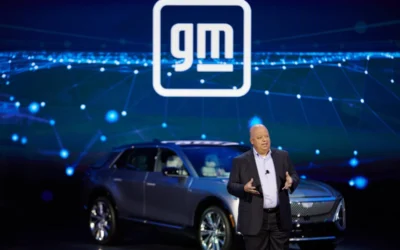


NEW YORK — General Motors is embarking on a pivotal technological transformation, aiming to pivot its century-old legacy toward a future defined by artificial intelligence, accelerated vehicle development, and sophisticated software architecture. Faced with an increasingly competitive global landscape, particularly from aggressive Chinese automakers, and a fluctuating domestic market, the Detroit-based giant used its "GM Forward" event in Manhattan on Wednesday to outline a comprehensive blueprint intended to reshape how it designs, builds, and powers its future fleet.
At the heart of this strategy is a commitment to drastically compress the time required to bring a vehicle from initial concept to the production line. Currently, the traditional automotive industry standard for vehicle development cycles spans four to five years. GM is now targeting a two-year window, a move executives argue is essential to remain relevant in a market where technology evolves at an unprecedented pace.
"Over the last 12 months, we’ve evolved how we design, engineer and build our vehicles," said Sterling Anderson, GM’s Chief Product Officer. Anderson, who has been tapped to lead this technological evolution, emphasized that the shift is not merely about speed for the sake of efficiency, but about achieving a higher level of performance that was previously unattainable within longer, more rigid development timelines. "There’s inherent virtue to speed," he noted during an interview following the event. "Not just in being able to get a car out faster, it’s being able to develop a system that’s far more performant than you could have otherwise."
This drive for agility comes as the industry grapples with the rise of Chinese EV manufacturers, which have gained significant ground by bringing products to market with remarkable speed and substantial cost advantages. According to data from the consulting firm AlixPartners, these competitors are currently launching vehicles roughly twice as fast as traditional automakers, while operating with 40% to 50% less investment and enjoying a 30% cost edge. To counter this, GM is betting on a "concurrent engineering model" that leans heavily into enterprise AI and virtualization, allowing the company to simulate and test components long before a physical prototype is ever constructed.
A prime example of this methodology is the development of GM’s next-generation battery technology. Before building a single physical prototype, the company utilized its virtual testing environments to evaluate over 300,000 different battery designs. This process focused on the company’s new lithium manganese rich (LMR) battery chemistry, which is set to become the exclusive power source for GM’s fourth-generation electric vehicles. This strategic pivot to LMR technology underscores GM’s commitment to optimizing its EV offerings, even as the company manages the complexities of current market adoption rates.
Next-Generation Vehicles and Computing Power
GM’s vision for the future extends beyond simple manufacturing speed; it encompasses a fundamental redesign of the vehicle’s "brain." The company announced that its upcoming lineup—comprising both electric and internal combustion engine models—will feature significantly upgraded electronic architectures. These vehicles will boast 40 times the computing power and up to 50% faster cellular connectivity than previous generations.
This jump in processing power is designed to support a robust ecosystem of over-the-air updates, sophisticated onboard diagnostics, and advanced AI-driven features. The technology is scheduled to make its debut in 2028 with the $130,000 Cadillac Escalade IQ EV, before cascading down to other high-volume models across the brand’s portfolio.

These next-generation vehicles are also being engineered with a focus on physical efficiency. GM expects these upcoming models to be 15% lighter and 25% more aerodynamic than current offerings, utilizing more compact electric motors and battery packs to maximize range and performance. Despite recent headlines regarding the scaling back of some short-term EV investments, GM President Mark Reuss reaffirmed the company’s long-term conviction. "We continue to develop our future EVs and work to reduce battery costs," Reuss stated. "And when the U.S. market is ready for EVs in large numbers, we will be there for them."
The AI Transformation and Personal Autonomy
A significant portion of GM’s "Forward" strategy centers on the integration of artificial intelligence into the customer experience, most notably through its proprietary OnStar AI assistant. While GM has previously utilized external systems like Google’s Gemini, the company is now moving toward a more integrated, internally developed AI agent. This assistant, which will be accessible via subscription, is designed to enhance productivity and comfort, particularly as vehicles gain more advanced autonomous capabilities.
This software-driven approach is also a direct challenge to competitors like Tesla, which has long set the pace for over-the-air updates and automated driving features. While Anderson, a former Tesla executive, declined to draw direct comparisons, he highlighted a key technical distinction: GM’s systems are designed to process data from a wide array of sensors, rather than relying exclusively on a camera-based approach. The company believes this multi-sensor strategy will provide a more reliable and "performant" foundation for its future driving technologies.
Perhaps the most ambitious component of GM’s roadmap is the reconfirmation of its "personal autonomy" goals. By 2028, the automaker intends to roll out eyes-off highway driving, a milestone that would allow motorists to safely divert their attention from the road. The technology will launch with the Cadillac Escalade IQ before expanding to other models. This goal, which has been in the works for several years, represents the culmination of Barra’s vision for the decade.
"Our vision is that eventually every vehicle should drive itself or its occupants anywhere, and we’re investing across the self-driving stack to make that real," Anderson said.
Underpinning these efforts is the vast trove of data GM has collected over its century of operation, supplemented by three decades of OnStar connectivity. Executives argue that this historical data gives the company a unique advantage in the AI era. "In the age of AI, data is currency," Anderson noted. "For decades, GM’s engineering, manufacturing and product teams have generated an unparalleled body of data that we’re now using to build industry-leading AI tools."
As GM looks toward 2028 and beyond, the success of the "GM Forward" plan will hinge on its ability to execute these complex technological shifts while simultaneously navigating the realities of a global automotive market in flux. For CEO Mary Barra, these initiatives are not just about incremental upgrades; they are about building the "car of the future" through a more agile, digital-first, and intelligence-led framework. Whether the company can successfully bridge the gap between its manufacturing heritage and its software-defined future remains the defining question for the Detroit automaker as it navigates the latter half of the decade.