
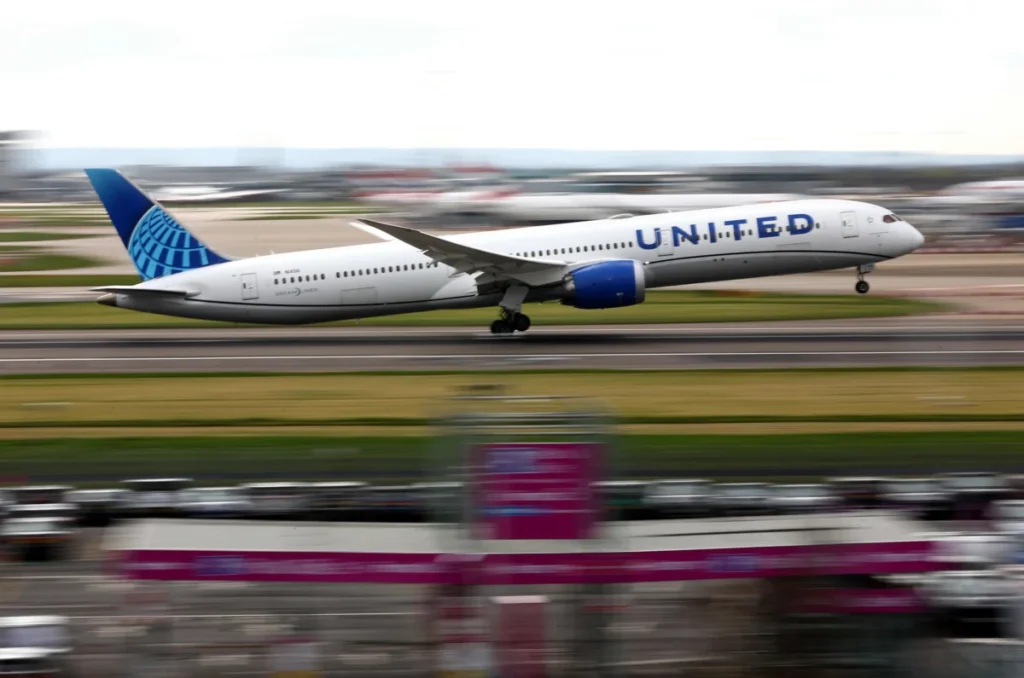
United Airlines announced a significant downward revision to its profit outlook for the remainder of the year, driven by a persistent surge in jet fuel prices that continues to bite into airline margins. Despite the dramatic increase in operational expenses, the carrier noted that consumer demand remains resilient, with passengers continuing to book flights even in the face of climbing airfares.
The major U.S. carrier revealed on Tuesday that it now expects to earn between 50 cents and $1.50 per share on an adjusted basis during the fourth quarter. This projection falls substantially short of the $1.76 per share that Wall Street analysts had anticipated. Taking the high end of that newly adjusted range into account, United’s total adjusted earnings for the full year 2026 will reach no more than $7.22 per share. This represents a sharp pullback from the carrier’s previous guidance issued in mid-July, at which time company executives projected full-year earnings between $9 and $11 a share.
The primary catalyst behind the reduced profit expectations is the escalating cost of energy. United reported that it expects to pay an average of $4.80 a gallon for jet fuel throughout the fourth quarter. This represents a marked increase from the average price of $3.90 a gallon that the airline paid during the third quarter.
Speaking with CNBC’s Phil LeBeau on Wednesday, United CEO Scott Kirby elaborated on the financial pressure facing the airline industry. Kirby stated that the carrier is currently passing along approximately 72% of the massive oil price surge directly to consumers through higher ticket prices. However, he emphasized that the airline aims to push that recovery rate closer to 100% as fuel markets remain volatile.
The broader aviation sector has wrestled with a steep surge in fuel prices throughout the year. This inflationary pressure has added billions of dollars to the operating costs of major carriers globally. While robust post-pandemic travel demand has helped buffer these financial hits to some extent, the surging expenses have continuously eaten into corporate profits and forced airlines to drive up airfares across both domestic and international routes.
Amid these broader economic headwinds, United reported its financial results for the third quarter, which ended September 30. The airline’s performance showcased a mix of higher revenues and rising expenditures, closely tracking analyst estimates compiled by LSEG.
For the third quarter, United’s net income rose 8.5% compared to the same period a year earlier, reaching $1.03 billion, or $3.14 a share. During the corresponding period last year, the airline’s net income totaled $949 million, or $2.90 a share. When adjusted for one-time items, United reported a net income of $833 million, or $2.54 a share, for the recent quarter.
Reflecting on the quarterly performance in an official earnings release, CEO Scott Kirby praised the workforce for navigating a complex operational landscape. "Our employees met the challenge of our ever-changing environment and our results prove the resilience of focusing on building a brand-loyal airline for customers," Kirby said.
The financial filings underscored the dramatic impact of commodity markets on airline overhead. United’s total fuel bill for the third quarter spiked by close to 62% compared to the previous year, mounting to $4.84 billion.
Despite the staggering jump in fuel expenses, the airline’s top-line revenue experienced strong double-digit growth. Total revenue for the three months ended September 30 rose 17.4% to $17.88 billion, up from $15.23 billion during the same period the year before. This revenue expansion was underpinned by higher ticket prices necessitated by rising operational expenses. Domestic passenger unit revenue increased by 14.5% from a year earlier, while international unit revenue saw an even sharper increase, rising 17.4%.
Management noted that these figures clearly illustrate the higher fares implemented across the network. Crucially, the airline emphasized that higher prices have not deterred travelers. Passenger counts remained robust, growing by more than 2% compared to the previous year as consumers continued to prioritize travel despite broader inflationary pressures within the economy.