
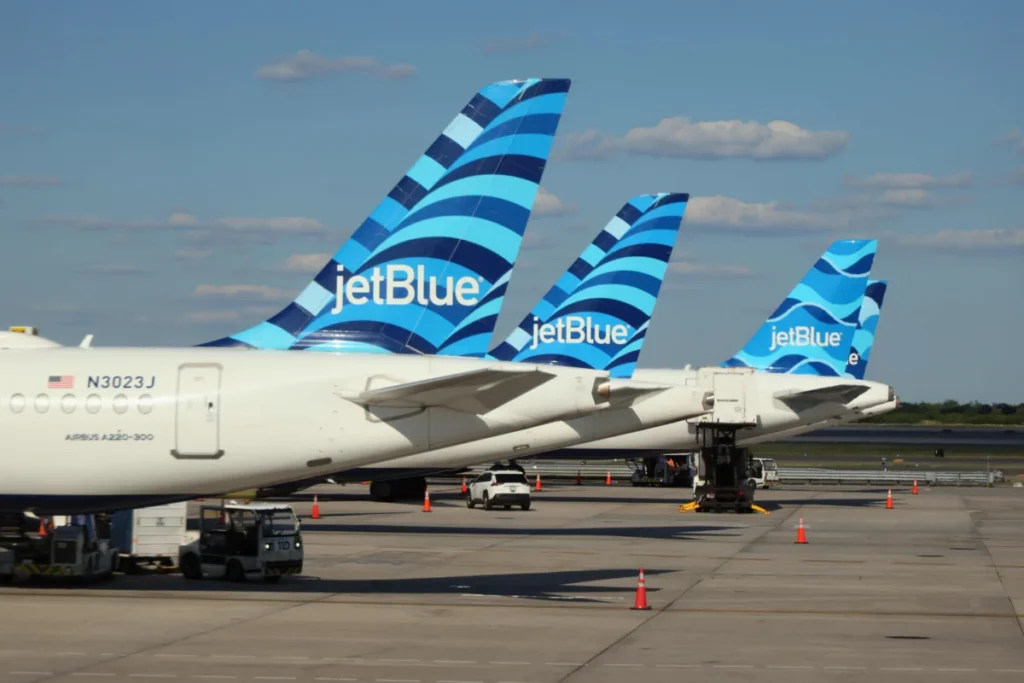
JetBlue Airways provided a complex snapshot of its financial trajectory on Monday, reporting a significantly wider net loss for the third quarter of 2026 while simultaneously offering an optimistic outlook that sent its shares climbing by roughly 11% in after-hours trading. The New York-based carrier, which has been grappling with a volatile macroeconomic environment, managed to soothe investor anxieties by highlighting resilient travel demand and a robust pricing strategy that has successfully mitigated the sting of soaring fuel expenses.
The financial results for the three months ending September 30 paint a stark picture of the current challenges facing the aviation industry. JetBlue reported a net loss of $257 million, a notable deterioration from the $143 million loss recorded during the same period last year. A primary driver of this deficit was an aggressive 61% surge in the airline’s fuel bill, which reached $868 million for the quarter. This inflationary pressure has acted as a persistent headwind, complicating the company’s efforts to return to profitability—a goal that has remained elusive since the airline last posted an annual profit in 2019.
Despite the bottom-line pressure, JetBlue’s leadership emphasized that the airline’s core operational metrics remain strong. CEO Joanna Geraghty framed the results as a testament to the carrier’s ability to navigate high-cost environments through pricing power and high demand.
"Resilient demand and strong yields drove revenue well ahead of our initial expectations, allowing us to recapture more of the increase in fuel costs than we initially expected," Geraghty said in an earnings release. "That momentum has carried into the fourth quarter, and Fort Lauderdale continues to deliver exceptional results even as we significantly grow capacity."
Evidence of this pricing power was clearly reflected in the company’s average fares, which rose more than 19% to $245.11 during the third quarter, up from $205.67 in the year-earlier period. This trend suggests that consumers remain willing to pay a premium for air travel, even as broader inflationary pressures continue to impact the economy and the cost of flying across the sector has increased by more than 20% over the course of the year.
The positive market reaction on Monday—a significant jump in after-hours trading—was a welcome development for a company that had seen its stock price fall to a new low earlier that same day. Investors have been increasingly jittery regarding the airline’s long-term financial health, a sentiment fueled by recent reports that a group of senior creditors has retained the services of restructuring adviser PJT Partners. This move has raised questions about how the carrier plans to manage its debt load and navigate its ongoing multiyear turnaround plan.
As of September 30, JetBlue reported a total debt of $8.4 billion. To provide reassurance regarding its stability, the airline emphasized that it finished the quarter with $2.2 billion in liquidity. Furthermore, the company highlighted an unencumbered asset base valued at $7 billion, which includes $2.8 billion in aircraft and engines, suggesting that the carrier has significant collateral available should it need to tap into financing markets.
CFO Ursula Hurley underscored the company’s commitment to fiscal discipline and its roadmap for recovery. "Importantly, we believe we have the liquidity and financing options to create a strong bridge to at least $1 EPS and positive free cash flow in 2028," Hurley said in a statement. "We remain focused on disciplined cost execution and capital management as we work toward sustained profitability and positive free cash flow."
The path to that 2028 target is multifaceted. JetBlue is currently executing a comprehensive turnaround strategy aimed at both cutting costs and revitalizing its revenue streams. A major component of this plan involves a pivot toward premium service offerings, most notably the introduction of a new domestic first-class section that recently went on sale. By diversifying its cabin offerings, JetBlue hopes to capture a higher-spending demographic, thereby insulating its revenue against the more price-sensitive segments of the market.
However, the road ahead is fraught with structural challenges. JetBlue has struggled not only with high fuel costs and operational expenses but also with the inherent difficulties of competing against much larger, well-entrenched legacy carriers. For years, the airline sought to scale its operations to better compete with these giants. Its most ambitious attempt—a planned acquisition of the low-cost carrier Spirit Airlines—was ultimately thwarted by a federal judge who ruled that the merger would be anticompetitive, dealing a significant blow to JetBlue’s expansion strategy.
Similarly, an earlier regional partnership with American Airlines, designed to bolster JetBlue’s presence in the highly congested Northeast U.S. market, was also blocked by a judge. These legal setbacks have forced the airline to reevaluate its competitive positioning. In the wake of these failed partnerships, JetBlue has pivoted, recently establishing a new partnership with United Airlines. This alliance represents a more conservative approach to growth, focusing on network cooperation rather than outright consolidation.
As executives prepare for an earnings call scheduled for Tuesday at 10 a.m. ET, the focus will undoubtedly shift toward these long-term concerns. Analysts are expected to press management on the details of the reported creditor engagement and the specific steps being taken to accelerate the transition to positive free cash flow. While the revenue figures and fare increases provide a degree of immediate comfort, the market remains focused on the underlying structural viability of the airline in a post-pandemic, high-fuel-cost reality.
The airline’s ability to grow capacity in key hubs like Fort Lauderdale while simultaneously maintaining the yield gains necessary to cover its ballooning fuel expenses will be a critical metric for observers. With the industry facing sustained pressure, JetBlue’s performance in the coming quarters will be closely scrutinized to determine if its turnaround strategy is gaining the necessary traction to turn the tide.
For now, the combination of strong consumer demand and a clear, albeit difficult, path to financial stabilization appears to have bought the airline some breathing room. As it heads into the final quarter of the year, JetBlue’s leadership remains focused on managing its liquidity and executing on its cost-reduction initiatives, hoping that these measures will be sufficient to navigate the competitive turbulence and return the company to a trajectory of sustained growth and profitability. The upcoming investor call will serve as a litmus test for whether the market’s current optimism can be sustained in the face of persistent, industry-wide economic headwinds.